
TRANSCRIPT
Fred Lorz jogs into the stadium looking almost fresh. Three hours and thirteen minutes after the gun, the crowd in St. Louis loses its mind. Alice Roosevelt, the president’s daughter, steps forward with a wreath. Cameras go up. The gold medal is inches from his neck.
And then somebody in the stands starts yelling that this man did not run the race.
That is not a spoiler. That is the cleanest moment in the entire afternoon. Everything before it was worse.
August thirtieth, nineteen oh four. The Olympic marathon starts a little after three in the afternoon, which is already a choice. Temperature in the nineties. Humidity thick enough to chew. The course is not today’s twenty-six point two miles. It is about twenty-four point eight five, laid over unpaved country roads outside the World’s Fair grounds, roads coated in inches of dust kicked up by automobiles, horses, and delivery wagons that share the route with the runners. There is one official water stop. One. Twelve miles in. The chief organizer, James Sullivan, is interested in what happens when athletes go without water. So the athletes go without water.
Thirty-two men start. Fourteen finish. Several nearly do not finish alive.
To understand how a race gets this broken, you have to meet the field. This is not a polished international elite. A lot of these guys are middle-distance runners, club athletes, and people who simply showed up. Two men from the Tswana people of South Africa are there as part of a World’s Fair exhibit. They become the first Black Africans in the modern Olympics. At least one of them will later get chased off course by a dog.
And then there is Félix Carvajal. Sometimes you will hear Andarín Carvajal. Cuban postman. Five foot one. He raised money to get to the Games by running exhibitions back home, lost the money in a dice game in New Orleans, and hitchhiked and walked the rest of the way to Missouri. He lines up in a long-sleeved shirt, full trousers, a beret, and street shoes. A fellow athlete takes pity and cuts the pants off at the knee with scissors. That is his racing kit.
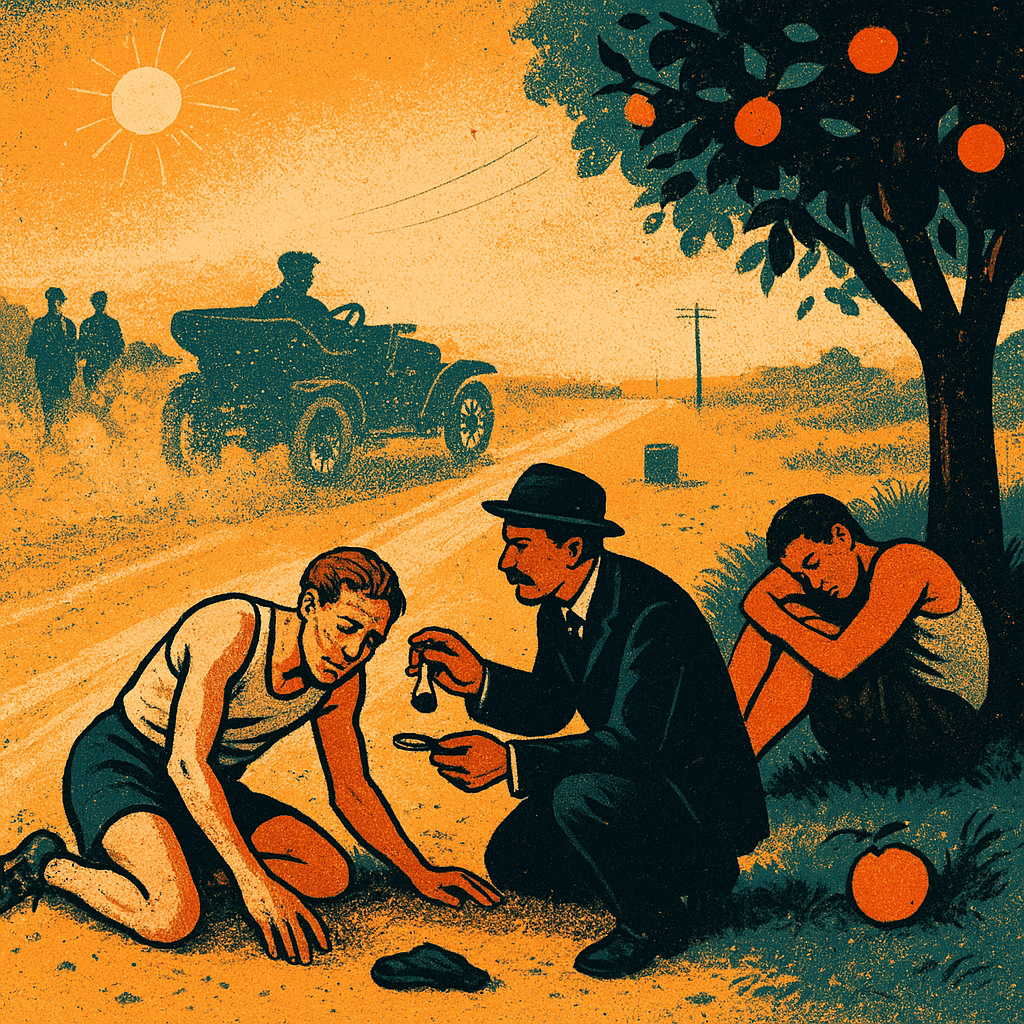
Carvajal runs with a kind of cheerful chaos. He chats with spectators in broken English. At one point he veers into an orchard and helps himself to peaches. Later accounts also have him snacking on apples that turn out to be rotten. Either way, his stomach revolts. So he lies down on the side of the road and takes a nap. A nap. Mid-Olympic marathon. He wakes up, gets back on the course, and still finishes fourth.
That is not the strangest medical story of the day.
William Garcia of California collapses around the halfway mark. Dust has coated his esophagus and torn his stomach lining. He is hemorrhaging. Doctors later say that if he had gone another hour without help, he might have bled to death. He becomes the closest thing the Olympics have had to a marathon fatality, and he is not even the headline.
The headline is supposed to be Fred Lorz.
Lorz is a New York bricklayer who trains at night. He runs well early, then cramps hard around mile nine. So he flags down a car. He rides. For roughly eleven miles. When the car breaks down near the stadium, he hops out and jogs the rest of the way in, smiling, waving, accepting the roar. Alice Roosevelt is ready with the wreath. Officials are ready with the medal. Then the witnesses catch up. Lorz has been seen in the automobile. He laughs it off as a joke. He says he never meant to keep the win. He is disqualified, banned, and later the ban is lifted, which tells you something about how seriously anyone was taking the paperwork in nineteen oh four. But in the moment, the “winner” evaporates.
Which leaves Thomas Hicks.
Hicks is an experienced English-born runner living in Massachusetts. He has been near the front for a long stretch. By the late miles he is not so much racing as surviving. His trainers make a decision that sounds, to modern ears, like a prank written by a poisoner. They give him strychnine sulfate.
Yes. Strychnine. The stuff in rat poison. In tiny doses it was a known stimulant at the time. They mix it with raw egg white. Later they add brandy. Hicks keeps moving, but he is coming apart. He is hallucinating. He thinks the finish is still twenty miles away when it is much closer. His face goes gray. His trainers have to hold him up in stretches and half-carry him forward. When he finally staggers into the stadium, he is barely vertical. His official time is three hours, twenty-eight minutes, fifty-three seconds. More than fifteen minutes slower than the winning time four years earlier in Paris. He is the champion, and he has to be supported across the line like a man delivered from a shipwreck.
He does not run again for years. The strychnine and the heat and the brandy have wrung him out.
So pause on what just happened. The first man across the line cheated by car. The real winner was dosed with a toxin, liquor, and eggs until he was seeing things that were not there. Fourth place took a fruit-induced nap. A man almost died from dust in his guts. Dogs entered the chase. Water was rationed on purpose. Cars and horses shared the road. And the whole thing was staged as a showcase of human excellence at a World’s Fair Olympics that already had a reputation for being half carnival.
Here is the part that sticks with me. We like to tell the story as pure slapstick, and it is slapstick. Stolen peaches. A nap. A hitchhiker in racing flats. A presidential daughter almost crowning a fraud. But underneath the jokes is something colder. This race is what you get when spectacle outruns care. When organizers treat bodies like experiments. When “amateur sport” still means almost no medical support, almost no course control, and a chemistry kit in the trainer’s bag that would get you banned for life today.
Strychnine as a performance aid sounds insane until you remember that early twentieth-century endurance sport was full of desperate pharmacology. Brandy, strychnine, heroin mixtures, oxygen, whatever someone swore by. Hicks did not invent doping. He just did it in public, on the biggest stage available, while the crowd still thought it was watching pure grit.
And Lorz’s car ride is funny until you notice how thin the line was between “competitor” and “guy who found a better way home.” The roads were open. The officiating was loose. The temptation was sitting there with the engine running.
Carvajal, though. Carvajal is the one I keep coming back to. He loses his money, cuts his pants, steals fruit, sleeps in the dirt, and still beats most of the field. He is not a symbol of anything tidy. He is just a stubborn human being who refused to treat the disaster as a reason to quit. In a race designed to break people, the postman from Havana finishes upright and smiling. That feels like the only clean win of the day, even if the medal went to the man full of rat poison.
Fourteen men finished. Eighteen did not. The official champion needed help to stand. The unofficial champion needed a motor. And somewhere back on a dusty Missouri road, a Cuban in chopped trousers woke up from a nap, checked the sun, and started running again.
That is the nineteen oh four Olympic marathon. Not the birth of the modern race. More like the warning label they forgot to print on the box.
If you want the deeper rabbit holes on times, names, and the disputed bits of Carvajal’s fruit stop, there are links in the show notes.