
TRANSCRIPT
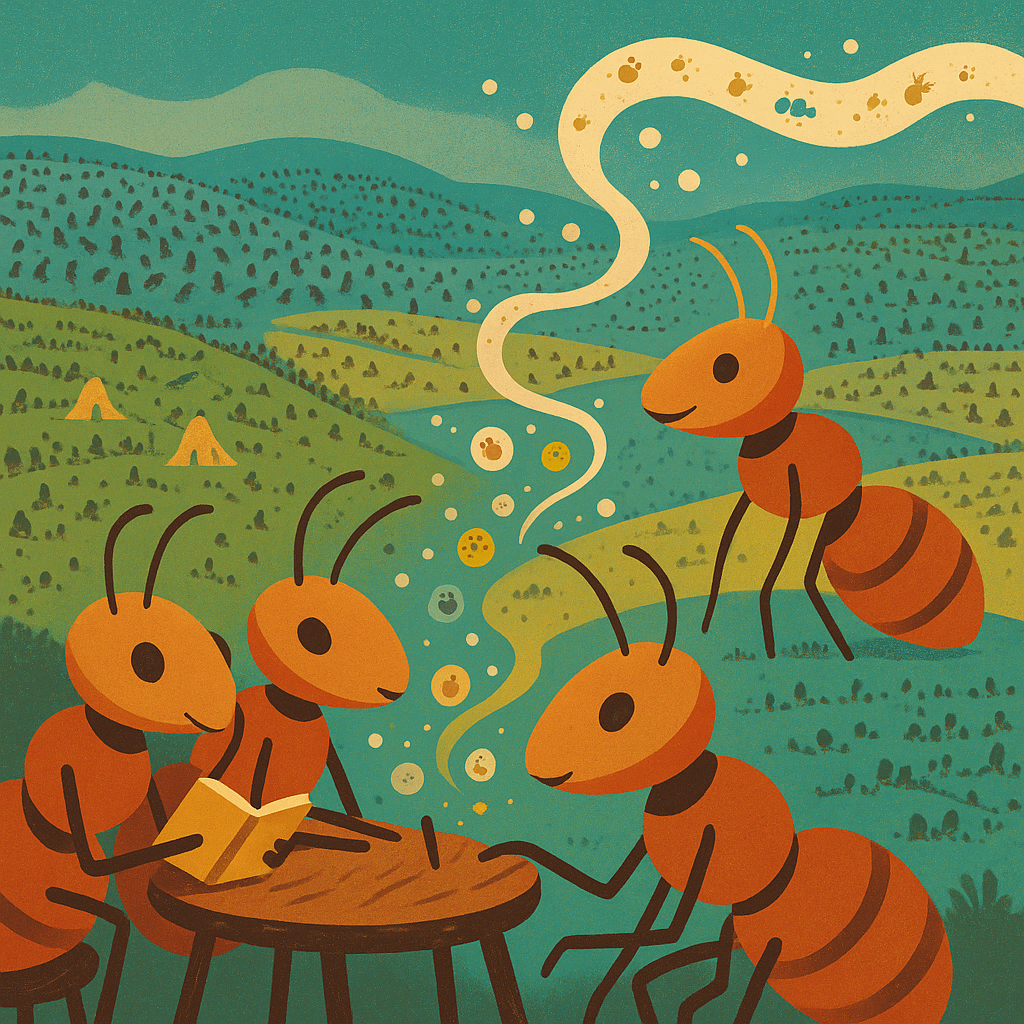
You hatch into a dark tunnel that smells like your entire extended family, and before you can even finish drying your brand new exoskeleton, somebody is already antennating your face like a bouncer checking I D.
Welcome to ant life. Your first question is not deep. It is not spiritual. It is: how many roommates is this.
Here is the honest answer. It depends wildly on which ant you are, and the range is so ridiculous it should be illegal.
Some ants live in a hollow twig with a dozen sisters and call that a civilization. Monomorphic species, the ones where workers all look roughly the same, clock in around a median of about one hundred forty individuals per colony. Polymorphic species, the ones with big-headed soldiers and tiny nurses, jump to roughly seven hundred fifty nine. That is the quiet end of the spectrum. The boring end. The starter apartment.
Then you get fire ants. Carpenter ants. Leafcutters. Suddenly you are talking tens of thousands, hundreds of thousands, sometimes millions of bodies sharing one nest system. And then, if the universe is feeling spicy, you get Argentine ants, which build supercolonies that stretch for miles and contain billions of workers who all treat each other like family because their chemical password never changed.
So when you ask how many ants you live with, the scientific reply is: somewhere between a book club and a mid-sized nation-state. Pick your species carefully.
But that is colony size. That is not how many ants you know.
Because here is the part that messes with the whole hive-mind fantasy. You do not know everyone. You cannot. Your brain is the size of a punctuation mark.
Ants recognize nestmates by smell. Specifically by a cocktail of hydrocarbons painted on their cuticle, like a living name tag made of grease. You walk up, you tap antennae, you sample the grease, and your nervous system goes either friend or absolute war crime. That is the whole social algorithm. No small talk. No birthdays. No remembering that Karen from foraging detail always takes the long route.
Researchers who mapped actual interaction networks in harvester ants found something almost rude. Individuals do not bounce around randomly chatting with everyone. They show restraint. Connectivity scales in a weird way as colonies get bigger. Per-capita interaction rate stays roughly steady, but in larger colonies each ant becomes relatively more insulated. You are not at a party of a million. You are in a crowded subway car where you keep elbowing the same forty commuters and everyone else is just background static that smells correct.
So how many ants do you know? Realistically, the ones you keep physically bumping into. Nestmates in your task group. The nurse who fed you when you were soft. The forager who ran the same trail. Dozens? Hundreds if you are busy and the nest is chaotic? Not millions. Your social world is local, chemical, and aggressively practical. Friendship is a repeated antennation that did not end in biting.
Now zoom out, because the numbers get unhinged.
At any given moment on Earth there are about twenty quadrillion ants. That is a two followed by sixteen zeros. Twenty quadrillion. A two thousand twenty-two analysis of nearly five hundred studies across continents put the figure at roughly two times ten to the sixteenth individuals, and the authors said that was conservative because nobody has properly counted the underground ones in northern Asia and central Africa yet.
That works out to something like two point five million ants for every single human alive. Their combined dry carbon biomass is about twelve megatons. Old cocktail-party wisdom said ants weigh as much as humans. Newer work knocked that down. They still outweigh all the wild birds and mammals on the planet put together. Just not us. We remain, for now, the heavier disaster.
So you, personal ant, live in a colony of maybe a hundred thousand, personally know a tiny fraction of them by grease-memory, and share the planet with twenty quadrillion strangers who would either ignore you or try to murder you depending on the smell test.
What does that life actually feel like, hour to hour.
You do not have a childhood. You have a larval stage where you are a soft comma that gets fed by older sisters, then a pupal nap, then boom, adult, job assignment incoming. Division of labor is real but flexible. Young workers often start inside, nursing brood, cleaning chambers, standing around looking useful. Older workers graduate to the dangerous stuff: foraging, defense, dying in the sun for a crumb.
Your day is a loop of stimulus and response so tight it would give a productivity influencer a nosebleed. Follow the pheromone. Pick up the thing. If the thing is too big, recruit. If something smells wrong, attack or run. If the queen's chemical signals say the colony needs more workers, the nursery shifts production. You do not vote. You do not unionize. You execute.
And yet it is not a mindless robot parade. Colonies solve problems. They build bridges out of their own bodies. They farm fungus. They enslave other ants, which is a whole dark podcast by itself. They wage wars with acid and jaws. They evacuate a nest when flooded and carry the babies in their mandibles like tiny frantic movers. The intelligence is distributed. No single ant understands the blueprint. The blueprint emerges from a million dumb local rules running in parallel, which is either beautiful or the most stressful group project in evolutionary history.
Your entire universe might be a few square meters of soil, a rotting log, the underside of a sidewalk square. You will probably never see the sky as a concept. You will see light gradients and temperature walls and the sudden godlike shadow of a shoe. Death is casual and constant. A forager's life expectancy outside can be measured in days or weeks. The colony does not hold a funeral. It reassigns the route.
Here is the surprise that sits under all of it.
From the outside, ants look like the ultimate collectivist fever dream. One mind, many bodies, no ego. From the inside, if inside is even the right word, you are a short-lived specialist running a chemical script in a dark hallway, surrounded by thousands of almost-yous who pass the smell test, while twenty quadrillion other ants on Earth are doing their own version of the exact same bit, completely unaware you exist.
You live with a city. You know a commute. You are statistically nothing. And the system works so well that ants have been pulling this off for more than a hundred million years, which is longer than your species has been arguing about whose turn it is to take out the trash.
So if you ever feel lonely in a crowd, consider the ant. She has two point five million colleagues per human, a nest full of sisters, and a social circle defined by whoever she can reach with her face-hands before lunch.
There are links in the show notes if you want the big census numbers and the colony-size studies. Try not to step on anyone on your way out.