

TRANSCRIPT
The beetle is the size of a cooked grain of rice. The tree is a Douglas-fir, eighty feet of northern Idaho swagger, older than your grandparents, and loaded with sticky chemical weapons. Locals also call it red fir, which is adorable, because the rice is about to paint the whole hillside that color anyway. And somehow the rice wins.
So here is the question that should bother you a little: how does something that small murder something that big?
Not slowly. Not over decades. In about a year, a healthy Douglas-fir can go from deep green to yellow to rusty red, and the neighbors can follow it like a bad trend. The short answer is bark beetles. The longer answer is weirder, meaner, and involves a fungus that hitchhikes like a roommate who never pays rent and also sabotages the plumbing.
Meet the Douglas-fir beetle. Scientific name Dendroctonus pseudotsugae, which is Latin for, roughly, tree-killer of the fake hemlock, because Douglas-fir is not a true fir and the scientists were feeling spicy. It is native to the Douglas-fir forests of western North America, including the big wet-and-then-suddenly-not woods of northern Idaho. It is not an alien invader. It has always been here, usually picking off the weak, the windthrown, the root-diseased, the drought-stressed. Think of it as the forest’s extremely aggressive quality-control department, with a specialty in trees thicker than about fourteen inches across.
Then, every so often, quality control gets a promotion and a megaphone.
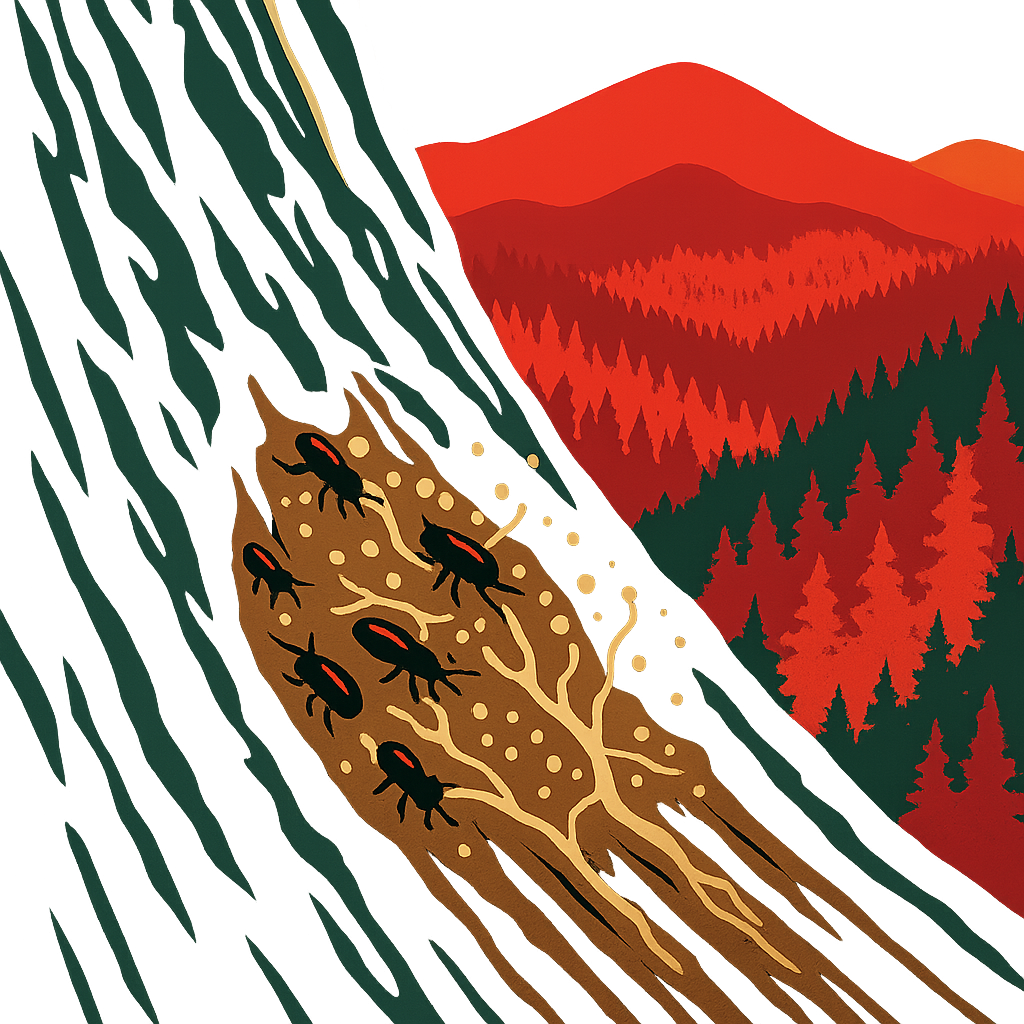
To understand the kill, you have to shrink down and watch one attack in a northern Idaho stand. A pioneer beetle lands on a Douglas-fir. She starts chewing through the bark. The tree’s first move is resin. Thick, sticky, toxic goo that can pitch a beetle right back out like a bouncer ejecting someone from a club in Coeur d’Alene. Healthy trees with good water can drown beetles in the stuff. Stressed trees cannot. And northern Idaho has no shortage of stress. Root diseases alone affect millions of acres up there, quietly kneecapping Douglas-fir, grand fir, and subalpine fir before any beetle ever shows up with a suitcase.
If she makes it in, she does not quietly settle down with a book. She releases aggregation pheromones. Insect perfume. A chemical billboard that says, in beetle, party here, free real estate, bring a date. Hundreds, then thousands of beetles answer. They mass-attack. They overwhelm the resin defenses the way a flash mob overwhelms a quiet cafe. One beetle is a snack for the tree. A few thousand is a siege.
Under the bark is the phloem. That is the tree’s living plumbing, the thin layer that moves sugars around. The beetles carve galleries through it. Then the eggs hatch, and the larvae keep chewing, girdling the tree from the inside. They are not eating the heartwood like cartoon termites. They are shredding the circulatory system while the tree is still standing there pretending everything is fine.
But wait. That is only half the murder.
Because the beetles did not come alone. They carry stain fungi, plus a sapwood-rotting fungus that is basically the demolition clause in the lease. The spores ride along on the beetle’s body, which is an evolutionary detail so extra it feels made up, except it is not. The fungi clog the water-conducting cells. The tree starts to die of thirst while also being eaten alive in the sugar layer. Unlike the flashy blue-gray stain you get in beetle-killed pines, the stain in Douglas-fir is quieter about the color, but the water cutoff is just as rude. The needles fade from green to yellow the next spring, then red by late summer. By the time the hillside looks like it got a discount dye job, the adult beetles are often already gone, packing for the next green giant down the ridge.
So the rice did not out-muscle the skyscraper. The rice threw a coordinated house party, invited a fungal demolition crew, and cut the pipes.
Which brings us to the part where the math gets ugly, specifically in Idaho. In twenty twenty-three alone, Douglas-fir beetle caused mortality on over thirty-four thousand acres statewide. That was a bump up from recent years. Outbreaks lit up after earlier messes, including places hammered by Douglas-fir tussock moth defoliation, plus the usual buffet of blowdown from windstorms. Northern Idaho has a long resume with this insect. Researchers have mapped Douglas-fir beetle infestations for years on places like the Priest Lake Ranger District, watching how one year’s dead trees seed the next year’s party. The beetle runs about one generation per year. Most overwinter as adults, fly in spring, and keep attacking into summer. Large-diameter trees get hit first. Once an outbreak kicks off in an area, it often runs two to three years hard, then cools, unless the forest keeps handing it free appetizers.
Outbreaks are not pure chaos. They are a pile-up of conditions. Drought weakens resin defenses. Windstorms drop fresh logs that beetles use like a gym membership before they graduate to standing trees. Fire-scorched trunks, root disease, crowded stands of big thirsty Douglas-fir. At low numbers the beetle is a janitor, cleaning up the already doomed. At high numbers it is a wildfire with legs and a group chat.
Now, you asked about evergreen trees and other trees of the sort. Fair. In northern Idaho the Douglas-fir beetle is the headliner for red fir, but it is not the only wood-boring assassin on the payroll. Secondary bark beetles, the opening acts, usually stick to tops, small trees, or hosts already on the ropes. Douglas-fir engraver, Douglas-fir pole beetle, a couple of Scolytus species with names only an entomologist could love. After the brutal drought stretch around twenty fifteen and twenty sixteen, those secondary players punched way above their weight and killed Douglas-fir across size classes in the north. Native wood borers, the longhorned beetles and the metallic flatheaded types, mostly clean up dead and dying wood. The Douglas-fir beetle did not get that memo when the conditions line up. It will take a big, apparently healthy red fir and put it on the to-do list.
And if you zoom out past the firs, the same business model shows up elsewhere. Emerald ash borer, different family, different vibe, metallic green, about a third of an inch long, larvae tunneling under ash bark across huge stretches of North America. Same thin living layer. Same girdling. Same rewrite of a whole urban forest by something you could lose in a shirt pocket.
So the pattern is not insects hate trees. The pattern is a few specialists that live in the thin living layer under bark, multiply fast when the host is stressed or abundant, and sometimes bring microbial partners that finish the job.
Here is the frame, the thing underneath the beetle trivia. A Douglas-fir in northern Idaho is a giant, slow, vertical bet on stability. A Douglas-fir beetle is a tiny, fast bet on timing. Most years the giant wins. Some years the calendar flips, a windstorm or a drought or a root fungus leans in, and the tiny thing coordinates. We like to think of those forests as scenery for a weekend drive up toward the lake. They are also a negotiation between organisms that do not care about your picnic plans.
And the strangest part? At normal levels, Douglas-fir beetle is not a villain in a cape. It thins weak trees, works the blowdown, opens gaps, recycles nutrients, shapes the woods for decades. The same insect that paints a northern Idaho ridge red is, in the quiet years, part of how the ridge stays a forest at all. The horror version is the outbreak version. Same species. Different volume knob.
So how does the rice kill the skyscraper? It does not arm-wrestle the trunk. It finds a crack in the defenses, texts every friend it has, floods the hallways, and lets a fungus shut off the water. One beetle is a curiosity. A pheromone-synchronized army with fungal backup is a regime change.
Next time you drive past a slope of red-needled Douglas-fir in northern Idaho, you are not looking at a mystery. You are looking at the aftermath of a very small, very organized, extremely sticky civil war. The trees lost. The rice went home to lay eggs. And somewhere under the bark of the next green giant, someone is already printing invitations.
There are links in the show notes if you want to dig into the Idaho forest health numbers.