
TRANSCRIPT
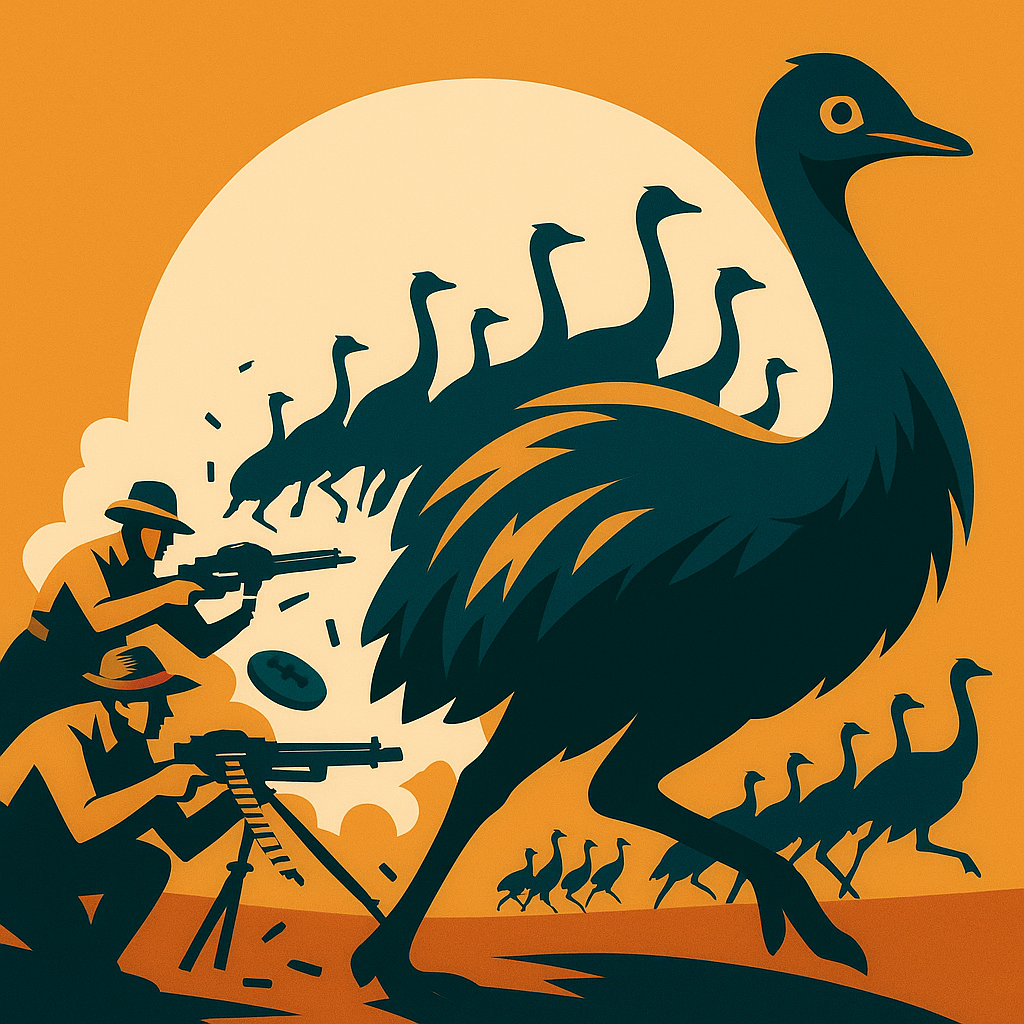
November second, nineteen thirty-two. Zero six hundred hours. A hot red-dirt landscape near Campion, Western Australia, halfway between Perth and Kalgoorlie. Two soldiers crouch behind a Lewis machine gun, ten thousand rounds of ammunition stacked beside them. Their commanding officer raises his field glasses and scans the horizon. Fifty enemy combatants come into view, moving as one, fast, low, and utterly indifferent to the fact that they are about to be shot at by the Australian military.
The enemy is an emu.
This is not a joke opening. This is a real operation, with a real officer, real government orders, and a real body count. And by the end of it, the birds will have done something almost no opposing force in the history of the British Commonwealth has managed. They will make the army retreat.
So here is the question worth sitting with for the next few minutes: how does a trained artillery unit, armed with weapons designed to mow down men in trench warfare, lose a fight against a flightless bird with a brain the size of a walnut? And what does that failure actually tell us, once you get past the punchline?
To understand how anyone ended up pointing a Lewis gun at a bird, you have to go back a year earlier, to the wheat farms of Western Australia. Nineteen thirty-two is deep in the Great Depression. Grain prices have collapsed. The federal government has just told farmers to increase wheat production anyway, promising subsidies that, as it happens, never fully arrive. So these are men already underwater financially, many of them veterans of the First World War, trying to hold a farm together on borrowed hope.
Then the emus show up. Not a few. Tens of thousands of them, by some estimates upward of twenty thousand birds, migrating inland after their breeding season in search of water and, as it turns out, freshly planted wheat. They flatten fences. They trample crops. They drink the water meant for livestock. To a farmer already on the edge, this looks less like a wildlife nuisance and more like an invasion.
So the farmers do what people who fought in the actual war know how to do. They organize, and they petition the government for machine guns. Specifically, they ask the Minister of Defence, Sir George Pearce, for military assistance. And Pearce says yes.
Now pause on that for a second, because that's the first real turn in this story. This isn't a rogue colonel deciding to declare war on birds. This is a formal request for military hardware, approved at the ministerial level, on the reasoning that Lewis guns are good at sustained fire and emus are numerous. It is, on paper, a rational decision. It is also, in retrospect, one of the strangest sentences ever typed on Australian government letterhead.
The operation is placed under the command of Major Gwynydd Purves Wynne-Aubrey Meredith of the Royal Australian Artillery's Seventh Heavy Battery. Under him, Sergeant S. McMurray and Gunner J. O'Halloran. Two men, two Lewis guns, ten thousand rounds. They arrive at Campion in early November with, frankly, the confidence of men who assume this will take an afternoon.
It does not take an afternoon.
On that very first day, a flock of around fifty emus is sighted. Meredith orders his men to circle wide and drive the birds into range of the guns, the same herding tactic you'd use on cattle. The emus do not cooperate. They scatter. Not in panic, but in a kind of loose, intelligent dispersal, breaking into small groups the moment the pressure builds, each group running in a different direction. By the end of that first engagement, out of the thousands of rounds fired, only about a dozen birds are dead.
Here's where you need to actually picture what's happening on the ground, because the numbers alone don't land it. A Lewis gun is heavy. It's accurate against a static or slow-moving target, like advancing infantry. It is a nightmare to swing and track against a target that can run around thirty miles an hour, changes direction without warning, and has a body built low and lean, so a lot of rounds simply pass over or beside it. The emus, without any understanding of ballistics, are behaving exactly like an enemy that has read the manual on evading machine-gun fire. They just don't get hit standing still, because they never stand still.
Two days later, on November fourth, it gets worse. Meredith's men spot a genuinely massive target, close to a thousand birds gathered in one place. This is the moment. This is what the whole operation was supposed to look like. They set the ambush. They wait. And then the gun jams.
A jammed machine gun in the middle of your one shot at the entire war. If you wrote that into a screenplay, a studio note would come back saying it's too on the nose. But it happened. The birds scatter before the gun is cleared, and the opportunity is gone.
By the end of the first week, Meredith is filing reports back to his superiors, and the tone of those reports is worth noticing, because it's not defensive. It's almost respectful. He observes that the emus have effectively adopted the organizational discipline of a fighting unit, with what he describes as leaders posted at the front of each mob to watch for danger while the others feed and move. Whether or not that's literally true emu behavior or just a commander's pattern-seeking under pressure, it's the moment the operation stops sounding like pest control and starts sounding like an actual after-action report on a losing campaign.
So let's total the ledger. Over about a month, from early November into December, the soldiers fire somewhere in the range of two and a half thousand rounds. The most commonly cited outcome is somewhere between fifty and a few hundred birds killed outright in that period, against a target population in the tens of thousands. Later official tallies, once bounty payments to farmers were factored in separately, put confirmed emu kills over the following months at closer to nine hundred eighty-six, but that's a different, longer program, not the machine-gun operation itself. The military phase, the actual Emu War, the one with Meredith and the Lewis guns, achieves something close to nothing.
And the public notices. Newspapers, both in Australia and overseas, start covering this with open amusement, and it's the press, not the army, that coins the term "Emu War." One member of Parliament, reportedly amused rather than alarmed, comments that the emus have won every round so far. By early December, the guns are withdrawn. No formal victory is declared, because there is no victory to declare.
Now here's the part worth sitting with, the part underneath the joke. This wasn't a failure of courage or effort. It was a failure of category. The army brought a weapon built for one kind of problem, an enemy that holds ground, forms lines, advances in the open, and pointed it at a problem that behaves nothing like that: fast, scattering, ungoverned by any front line at all. That mismatch between the tool you have and the shape of the thing you're actually fighting is not unique to emus. It shows up any time an institution tries to solve a diffuse, adaptive problem with a blunt, centralized instrument, and expects the problem to politely stand still and get hit.
The emus, for their part, never surrendered, never negotiated, and never even understood there was a war on. They just kept doing what emus do, which turned out to be the only strategy that mattered. The farmers eventually got their fences, subsidized by the government instead of guns, and the crop damage was managed the boring, unglamorous way: barriers, not battles.
So if you ever hear someone say Australia lost a war to a bird, that part's true. But it's less that the emus were secretly brilliant tacticians, and more that nobody stopped to ask if the enemy they were imagining actually existed. Which might be the most human military mistake there's ever been, feathers or no feathers.