
TRANSCRIPT
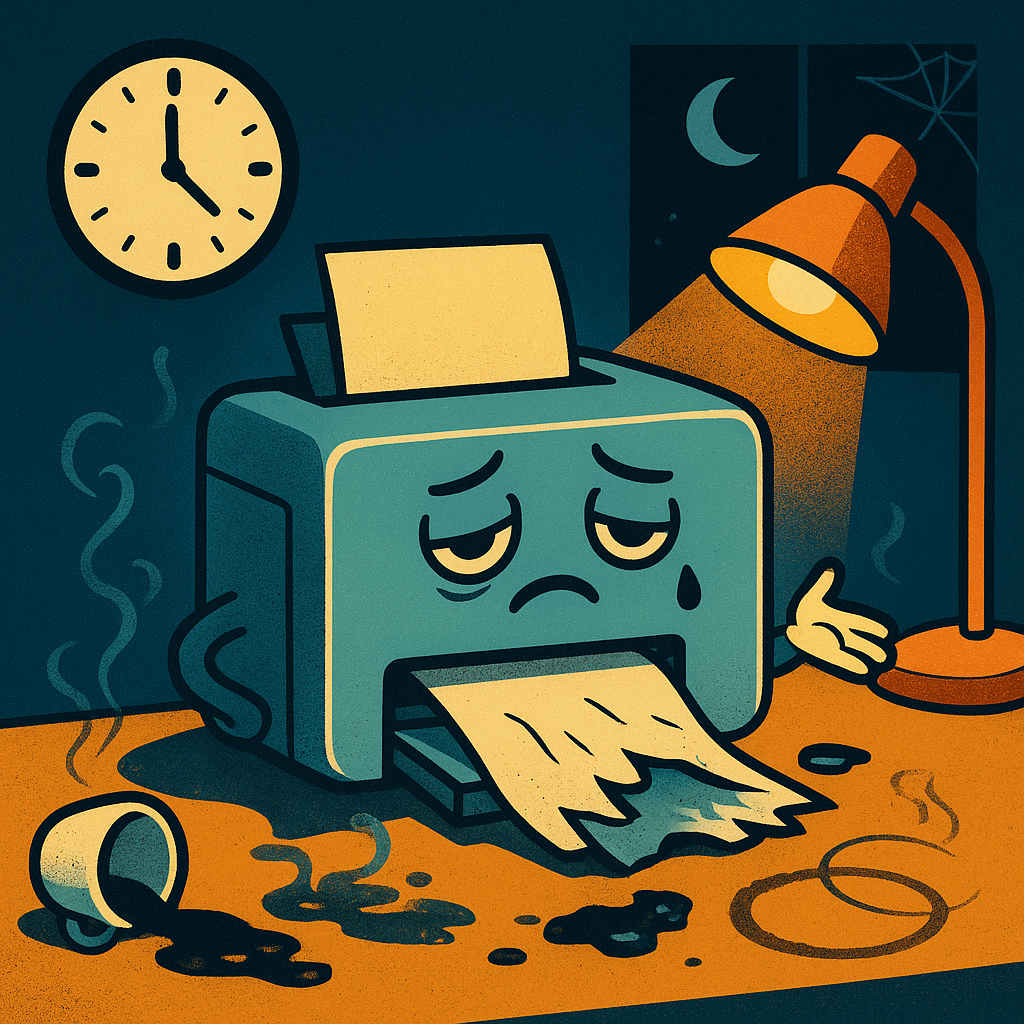
You are standing at the printer at eleven forty-seven at night, holding a USB stick like a hostage negotiator, and the machine has just made that little mechanical sigh that means nothing good. The document is due at midnight. The status light is blinking orange. Somewhere in the tray, a single sheet of paper has folded itself into origami and died.
And you think, of course. Of course it breaks now.
I am here, on behalf of every inkjet, laser, and multifunction box that has ever ruined your evening, to say we are sorry. Truly. Formally. The whole category extends its regrets. We know how this looks. We know the timing is unforgivable. What I want to do is explain why the timing is not a personality. It is physics wearing a very convincing mask of spite.
Here is the thing almost nobody says out loud. Printers do not break more often when you are late. You only notice them when you are late. The rest of the time, when the thing quietly spits out a boarding pass on a Tuesday at two in the afternoon, your brain files that under weather. Fine. Expected. Not a story. The failure becomes a story the second the stakes go up. That is not the printer hunting you. That is your attention hunting drama.
But stick with me, because the physics is worse than the psychology, and also kind of beautiful in a tragic way.
Most home printers are inkjets. Inside the printhead sit nozzles so small you could lose them in a freckle. The ink is not colored water. It is a suspension of dye or pigment particles held in a carrier fluid, usually water mixed with glycol and a cocktail of stabilizers. That carrier is what keeps the ink thin enough to fly through those microscopic holes. The second the fluid meets open air, evaporation starts. Water leaves. What stays behind gets thicker, stickier, and eventually hard. A plug forms. The nozzle dies. Your page comes out with a white stripe where a sentence used to be.
How long does that take? Go more than about two or three weeks without printing, and you are in the danger zone. Dry indoor air makes it faster. Heat near a window makes it faster. Turning the printer off at the wall instead of its own power button can leave the head uncapped, exposed, drying like a forgotten paintbrush. Manufacturers know this. That is why the manuals, in the fine print nobody reads, basically beg you to print something once a week. Anything. A test page. A grocery list. A haiku about your own procrastination. The machine needs to move ink the way a joint needs to bend.
So picture the actual sequence of your life. You do not print for three weeks because who prints anymore. Then, on the night something matters, you wake the machine from its long sleep and demand a perfect twelve-page PDF with color charts. The nozzles have been slowly turning into concrete. You are not unlucky. You are the person who only stretches before the marathon.
Which brings us to the paper jam, the other classic betrayal.
Paper jams are the number one complaint in offices. One survey of thousands of support tickets put them at the top of the heap. Roughly two fifths of jams come from how the paper was loaded. Overfilled tray. Misaligned stack. Sheets that stuck together because someone left the ream in a damp closet. Another quarter or so come from the paper itself being wrinkled, cheap, or slightly humid. Worn rollers account for a chunk of the rest. Now ask yourself what you do when you are already late. You grab whatever paper is left. You fan it once, maybe. You shove the stack in crooked because the tray spring is fighting you and the clock is fighting you harder. You hit print like you are starting a drag race. The machine did not choose this moment. You handed it the worst possible inputs at the worst possible time and then acted shocked when the physics agreed with you.
There is a number I like for the scale of this misery. One workplace study put the average office employee at about twenty-two minutes a week lost to printer problems. That is nearly nineteen hours a year, per person, spent in a staring contest with a plastic box. Multiply by a company and you get a small unpaid department whose only job is rage.
I should be fair to the other side of the argument. Printers are also, in many cases, badly designed for repair. Community repair data has shown success rates under forty percent at fix-it events, partly because spare parts and manuals are locked down, especially on cheaper models. Cartridges are priced like perfume. Drivers vanish after operating system updates. Wireless setup is a small religious trial. Some of the hatred is earned. The industry has spent decades training you to expect betrayal, then selling you a new unit when the old one sulks. I am not here to absolve the business model. I am here to separate the business model from the Tuesday night clog.
Because the clog is not a conspiracy. It is evaporation meeting neglect meeting urgency. The jam is friction meeting haste. The blinking light that says the cartridge is empty when you installed it yesterday is sometimes a genuine sensor and sometimes a firmware tantrum, and either way it arrives when you have zero margin left, so it feels personal.
Here is the larger thing underneath the tiny nozzles.
We built a culture where the important document is always last-minute, and we built a machine that hates being ignored. Those two facts are in a long, slow collision. The printer is one of the last devices in your house that still has moving parts, liquid, paper dust, and a mechanical path that can go wrong in twelve different places. Your phone does not jam. Your laptop does not dry out if you leave it closed for a month. The printer is an industrial process shrunk into a beige rectangle and asked to hibernate under a pile of mail until the night before the deadline. Of course the failure clusters around the deadline. That is when the dormant machine meets the desperate human.
So the apology, properly stated, goes like this.
We are sorry we made you feel hunted. We are sorry the orange light has the emotional range of a fire alarm. We are sorry the cleaning cycle eats two to five percent of a cartridge just to cough, and that a deep clean can drink even more, and that after two failed cleans the honest move is often a manual soak you should not have to learn at eleven fifty. We are sorry the rollers polished themselves smooth on a thousand junk mail pages and then chose your thesis. We are not sorry for the laws of evaporation. Those were here first.
If you want a truce, it is almost insultingly simple. Print a page once a week. Use the power button on the machine. Do not overfill the tray. Keep the paper dry. When something actually matters, give yourself one extra hour you will resent until the moment the page comes out clean. That hour is not paranoia. It is respect for a device that still has to push liquid through holes the width of a thought.
You will still hate us sometimes. That is allowed. Hate is part of the relationship. Just know, the next time you are late and the tray jams and the universe feels arranged against you, that the arrangement was mostly yours. The ink was drying the whole time you were fine. The night you needed it was simply when you finally looked.
We will be here under the mail pile, capped and waiting, trying not to turn into glue. Try us on a boring afternoon sometime. You might almost like us.